Every business reaches a point where growth creates a new challenge. More customers mean more emails, more enquiries, more reports, more follow-ups, and more administrative work. Before long, your team spends more time managing tasks than growing the business.
Over the past 27+ years working with businesses across the GCC, UAE, KSA, and international markets, I’ve seen this happen in companies of every size. The issue is rarely a lack of effort. Most teams work incredibly hard. The real problem is that too many repetitive processes depend on people instead of systems.
That’s why AI agents and automated workflows have become one of the most exciting developments in business technology.
Unlike traditional automation, AI agents don’t just follow fixed rules. They can understand requests, make decisions within defined limits, connect multiple business applications, and complete tasks with minimal human involvement.
Used correctly, they don’t replace your team—they help your team focus on work that genuinely creates value.
What Are AI Agents?
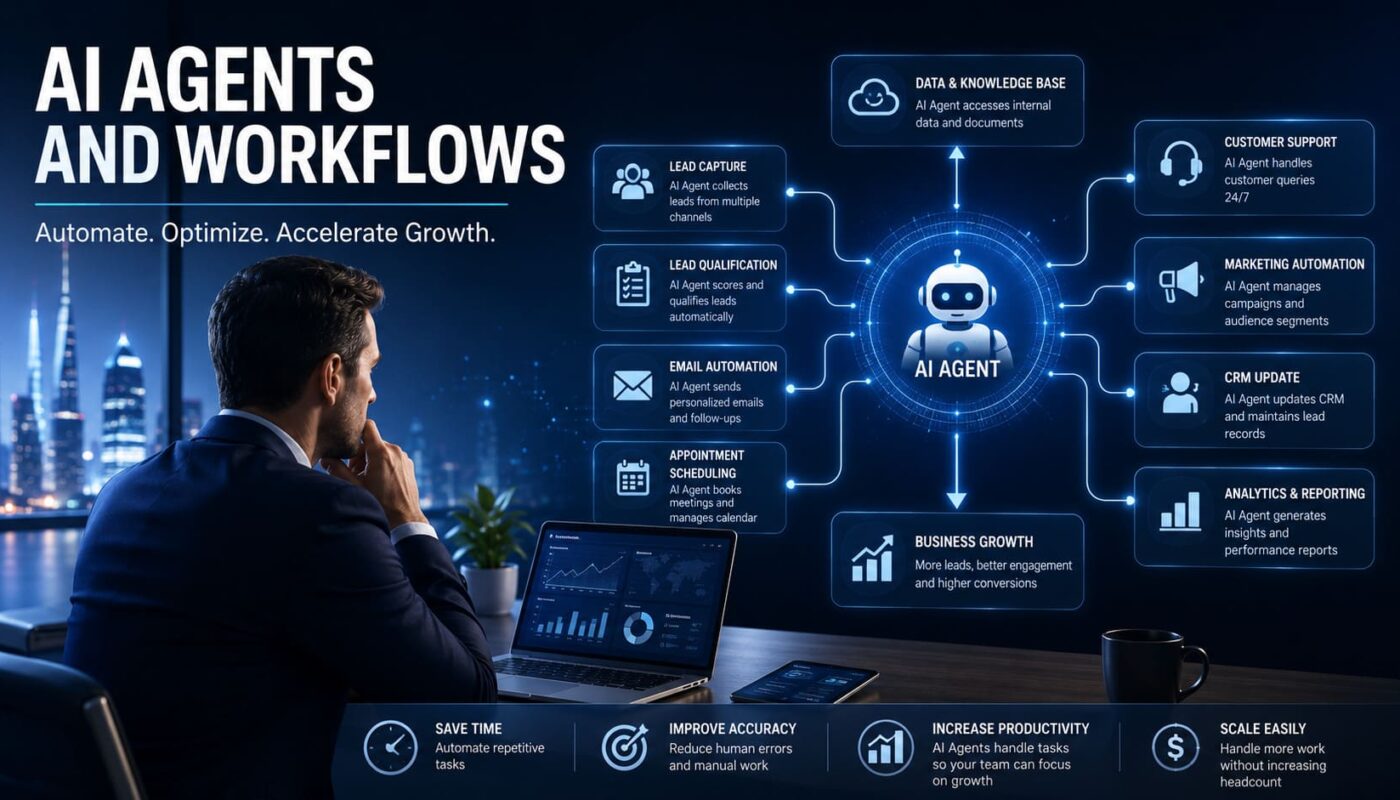
An AI agent is an intelligent software assistant that performs tasks on behalf of a business.
Instead of waiting for manual instructions every time, an AI agent can:
- Read incoming emails
- Understand customer requests
- Generate responses
- Update CRM systems
- Schedule meetings
- Create reports
- Research information
- Trigger other business processes
Think of it as a digital employee working alongside your team 24 hours a day.
The difference between a chatbot and an AI agent is simple.
A chatbot answers questions.
An AI agent completes tasks.
What Are AI Workflows?
- An AI workflow connects multiple business activities into one automated process.
- For example:
- Customer submits enquiry →
- AI agent reads enquiry →
- Creates CRM lead →
- Sends personalized email →
- Notifies sales team →
- Schedules follow-up →
- Updates reporting dashboard
- Everything happens automatically.
- Without AI, several employees might be involved.
- With a properly designed workflow, most of the routine work disappears.
Why Businesses Are Investing in AI Agents
Business owners constantly ask me how they can increase productivity without continuously hiring more staff.
AI workflows often provide the answer.
They help businesses:
- Save time
- Reduce manual errors
- Improve response speed
- Increase consistency
- Deliver better customer experiences
- Scale operations without dramatically increasing costs
This is especially valuable for startups and SMEs where every employee already manages multiple responsibilities.
Where AI Agents Create the Biggest Business Value
Marketing Automation
Marketing involves dozens of repetitive activities.
AI agents can automatically:
- Publish content
- Schedule social media posts
- Monitor website enquiries
- Generate reports
- Organize marketing data
- Create campaign summaries
This allows marketing teams to focus on strategy rather than administration.
SEO Workflows
- SEO requires ongoing work.
- Keyword research.
- Content planning.
- Internal linking.
- Performance monitoring.
- Technical improvements.
- In my experience working with GCC clients, many businesses focus more on design than SEO structure.
- Their websites often look impressive, but the SEO foundation is weak.
- AI workflows can automate many routine SEO activities, allowing specialists to focus on optimization rather than manual research.
- One common mistake I notice is that websites are built without proper keyword targeting.
- AI can help identify opportunities, but businesses still need an experienced SEO strategy behind every decision.
Content Marketing
Consistency wins in content marketing.
Unfortunately, consistency is exactly where many businesses struggle.
I have seen many businesses struggle with getting consistent traffic due to lack of content strategy.
AI agents help by:
- Generating topic ideas
- Organizing content calendars
- Drafting outlines
- Repurposing articles
- Creating social media snippets
- Suggesting internal links
Human review remains essential, but AI significantly reduces production time.
Sales Automation
Sales teams spend far too much time on administrative work.
AI agents can:
- Qualify leads
- Send follow-up emails
- Update CRM records
- Generate quotations
- Schedule meetings
- Notify sales representatives
Instead of replacing sales professionals, AI gives them more time to build relationships with customers.
Customer Support
Modern customers expect fast responses.
AI workflows can automatically:
- Categorize enquiries
- Answer common questions
- Create support tickets
- Escalate complex issues
- Track customer satisfaction
This improves service quality while reducing pressure on support teams.
Real Business Benefits of AI Workflows
From what I’ve seen across different industries, businesses implementing AI workflows often notice improvements in several areas.
Faster Response Times
Customers receive replies within minutes instead of hours.
Better Productivity
Employees spend less time on repetitive administration.
Improved Accuracy
Automation reduces human error in repetitive processes.
Better Customer Experience
Consistent communication builds trust.
Higher Business Scalability
Companies can handle increased workloads without proportionally increasing staff.
Practical Steps to Implement AI Agents
Many businesses believe they need to automate everything immediately.
I strongly disagree.
The best approach is gradual implementation.
Step 1: Map Your Existing Processes
Document repetitive tasks.
Identify bottlenecks.
Understand how work currently flows.
Step 2: Prioritize High-Impact Tasks
Focus on tasks that consume the most time.
Examples include:
- Email responses
- Lead qualification
- Report generation
- Customer enquiries
Step 3: Build One Workflow
Start with a single automation.
Measure results.
Improve it.
Then expand.
Step 4: Keep Human Approval
Not every decision should be automated.
Allow humans to review important customer communication and strategic decisions.
Step 5: Monitor Performance
Measure:
- Time saved
- Response speed
- Customer satisfaction
- Lead conversions
- Employee productivity
Good workflows improve continuously.
Common Mistakes Businesses Make
After consulting with companies for many years, I regularly see these mistakes.
Automating Poor Processes
Automation accelerates existing processes.
If those processes are inefficient, automation simply makes poor systems faster.
Trying to Replace Employees
AI should support your team.
The goal is better productivity—not fewer people.
Ignoring Business Strategy
Technology without strategy creates complexity.
Every workflow should support a clear business objective.
Creating Too Many Workflows
Start small.
Master one automation before building ten more.
Forgetting SEO and Content
Businesses often automate marketing while ignoring the content customers actually search for.
From my experience over the years, long-term SEO success depends on content quality and backlinks.
AI agents can speed up production, but valuable content still requires expertise.
A Real Example From My Experience
- A real example from my projects is a client who improved leads by restructuring their website and publishing consistent blog content.
- Once the website was properly organized, we introduced simple workflow automation to support enquiries, content planning, and follow-up emails.
- The automation itself wasn’t complicated.
- The biggest improvement came from creating a structured system where marketing, SEO, and lead management worked together.
- Technology supported the process.
- Strategy delivered the results.
Final Expert Recommendation
- AI agents and workflows represent one of the biggest opportunities for businesses over the next few years.
- However, don’t make the mistake of thinking automation alone creates success.
- Your customers still value trust.
- Your employees still provide creativity.
- Your business still depends on good strategy.
- Use AI agents to remove repetitive work.
- Use workflows to improve efficiency.
- Then invest the time you’ve saved into creating better products, stronger customer relationships, and higher-quality content.
- After more than 27 years working with businesses across multiple industries, I’ve learned that sustainable growth doesn’t come from working harder.
- It comes from building smarter systems.
- AI agents and workflows are simply another step toward that goal.