Every few years, a new technology comes along that promises to transform marketing. Most create excitement for a while before fading into the background. Artificial intelligence is different.
After working in digital marketing, web development, SEO, and online business for more than 27 years, I genuinely believe AI is changing how businesses operate. Not because it replaces marketers, but because it removes many of the repetitive tasks that consume valuable time.
The businesses seeing the biggest results are not necessarily using the most expensive AI tools. They are using AI strategically. They understand where automation saves time, where human creativity still matters, and how to combine both effectively.
If you’re a business owner, startup founder, marketing manager, or SME looking to improve your online presence, understanding how AI fits into your marketing strategy is becoming less of an advantage and more of a necessity.
What Does AI in Digital Marketing Really Mean?
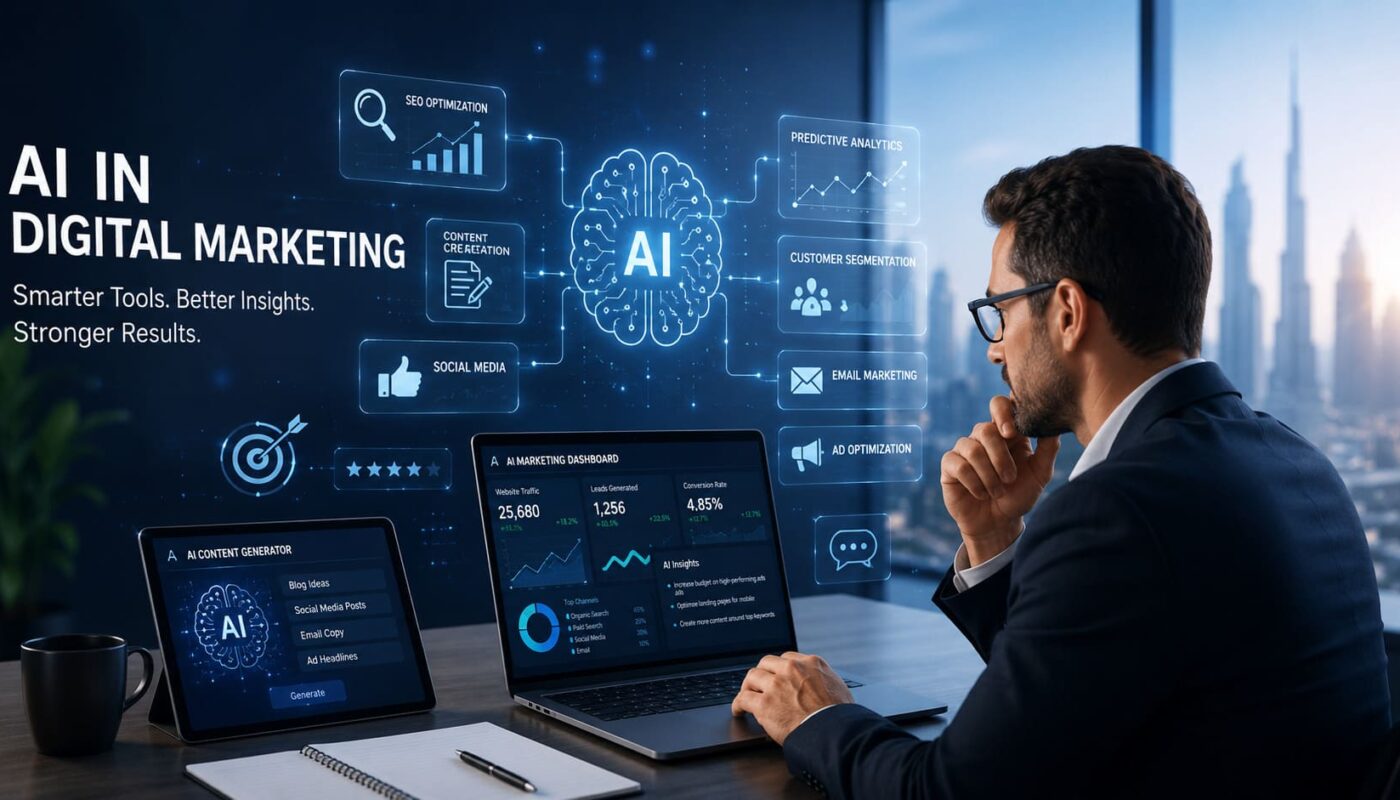
AI in digital marketing simply means using artificial intelligence to improve marketing activities such as:
- Content planning
- SEO research
- Email marketing
- Advertising optimisation
- Customer engagement
- Social media management
- Lead generation
- Data analysis
- Marketing automation
The objective isn’t to let AI run your marketing. It’s to allow your team to spend more time making strategic decisions instead of repeating manual tasks.
Think of AI as an intelligent assistant rather than a replacement for your marketing team.
Why More Businesses Are Adopting AI
Business owners are under constant pressure to do more with limited time and resources.
Marketing channels continue to expand. Customers expect faster responses. Search engines constantly update their algorithms. Content demand keeps increasing.
Managing all of this manually has become difficult.
AI helps businesses by reducing repetitive work while improving consistency.
From my experience, companies that use AI wisely are usually able to:
- Produce content more consistently
- Improve customer response time
- Analyse marketing performance faster
- Personalise customer communication
- Reduce operational workload
- Make better marketing decisions based on data
The technology itself is not the competitive advantage.
How you use it is.
AI Is Changing SEO More Than Many Businesses Realise
SEO remains one of the strongest long-term marketing investments.
Unfortunately, many businesses still misunderstand how it works.
In my experience working with GCC clients, many businesses focus more on design than SEO structure.
They invest heavily in attractive websites but pay little attention to technical SEO, keyword strategy, internal linking, or content planning.
The result is predictable.
Beautiful websites that receive very little organic traffic.
One common mistake I notice is that websites are built without proper keyword targeting.
Businesses create pages based on what they want to say instead of what customers are actually searching for.
AI can now assist with:
- Keyword research
- Search intent analysis
- Content clustering
- Content briefs
- Meta descriptions
- Internal linking suggestions
- Technical SEO recommendations
However, AI should support your SEO strategy—not replace it.
From my experience over the years, long-term SEO success depends on content quality and backlinks.
No AI tool can substitute genuine expertise, trust, and authority.
AI Makes Content Marketing More Efficient
Content continues to drive organic traffic, educate potential customers, and build trust.
The challenge is consistency.
I have seen many businesses struggle with getting consistent traffic due to lack of content strategy.
Publishing one blog every few months rarely delivers meaningful SEO results.
Businesses that publish useful content regularly almost always outperform competitors over time.
AI helps by speeding up:
- Topic research
- Article outlines
- First drafts
- Headline ideas
- Meta descriptions
- Social media captions
- Email newsletters
The biggest mistake is publishing AI-generated content without adding personal knowledge.
Readers can immediately recognise generic advice.
Real experience creates credibility.
Whenever I publish or recommend content, I always encourage adding real examples, practical lessons, and honest opinions.
That’s what separates valuable content from content that simply fills a page.
AI Improves Paid Advertising Performance
Managing advertising campaigns has become more data-driven than ever.
Platforms such as Google Ads and Meta Ads already use AI extensively behind the scenes.
Businesses can now use AI to:
- Generate multiple ad variations
- Predict campaign performance
- Optimise bidding strategies
- Improve audience targeting
- Analyse conversion data
- Identify underperforming campaigns
This doesn’t remove the need for experienced campaign management.
Poor offers and weak landing pages still produce poor results regardless of how advanced the technology becomes.
Better Customer Experiences Through AI
Customer expectations continue to increase every year.
People expect businesses to respond quickly.
AI-powered chatbots and virtual assistants can now:
- Answer common questions
- Qualify leads
- Schedule appointments
- Recommend products
- Route inquiries to the correct department
This allows businesses to improve customer service without significantly increasing staff.
More importantly, it ensures customers receive assistance even outside normal working hours.
AI Helps Businesses Understand Their Data
Most businesses collect large amounts of marketing data.
Very few actually use it effectively.
AI simplifies complex information by identifying trends that would otherwise take hours to discover manually.
It can identify:
- High-performing campaigns
- Customer behaviour patterns
- Sales opportunities
- Seasonal demand
- Content performance
- Conversion bottlenecks
Better decisions begin with better insights.
AI simply helps businesses find those insights faster.
Practical Ways to Introduce AI Into Your Marketing
Many companies make the mistake of trying to automate everything immediately.
I recommend a much simpler approach.
Step 1: Identify Time-Consuming Tasks
Look at activities your team repeats every week.
These usually offer the fastest return on investment.
Step 2: Start With Content
Content creation often consumes the most time.
Use AI to assist with research, planning, and first drafts while keeping final editing entirely human.
Step 3: Automate Lead Nurturing
Set up automated email sequences for new inquiries.
This ensures every lead receives timely communication.
Step 4: Improve SEO Workflows
Use AI to identify keyword opportunities and organise content ideas.
Then apply human expertise to produce valuable articles.
Step 5: Review Performance Monthly
AI should improve measurable outcomes.
Monitor:
- Organic traffic
- Lead quality
- Conversion rates
- Engagement
- Cost per acquisition
- Content performance
If results aren’t improving, adjust your strategy.
Common Mistakes Businesses Make
After years of consulting with companies across different industries, I see several mistakes repeatedly.
Using AI Without a Marketing Strategy
Technology cannot compensate for unclear business goals.
Start with strategy first.
Publishing Generic Content
AI-generated content without editing often sounds repetitive and lacks credibility.
Always add your own experience and industry knowledge.
Ignoring SEO Fundamentals
Many businesses assume AI alone will improve rankings.
Search engines still reward helpful, relevant, and trustworthy content.
Chasing Every New AI Tool
Every week introduces another platform claiming to change marketing forever.
Most businesses need only a handful of reliable tools.
Master those before expanding.
Forgetting the Human Element
Marketing remains about people.
Relationships, trust, and reputation still influence buying decisions far more than automation alone.
A Practical Example From My Experience
A real example from my projects is a client who improved leads by restructuring their website and publishing consistent blog content.
Their original website looked modern but attracted very little organic traffic.
We reorganized the website structure, improved keyword targeting, created helpful educational content, strengthened internal linking, and used AI tools to speed up research and content planning.
Over time, search visibility improved, enquiries increased, and the business became less dependent on paid advertising.
The AI tools certainly helped.
But the strategy behind the implementation made the real difference.
Final Expert Recommendation
- AI is changing digital marketing, but it isn’t replacing the fundamentals.
- Businesses still need clear positioning, useful content, strong SEO, effective websites, and a genuine understanding of their customers.
- Think of AI as a productivity multiplier rather than a shortcut.
- Use it to eliminate repetitive work, organise information faster, and improve efficiency—but continue relying on human experience when making strategic decisions.
- After more than 27 years working with businesses throughout the GCC and international markets, one lesson remains consistent.
- The businesses that succeed aren’t always the ones with the biggest budgets.
- They’re the ones willing to keep learning, adapt to change, publish valuable content consistently, and invest in long-term marketing instead of chasing quick wins.
- If you approach AI with that mindset, it can become one of the most valuable additions to your digital marketing strategy.